
May 30, 2026
ACL Injury Rehabilitation: Why Criteria-Based Recovery — Not a Calendar — Determines Your Outcome
“You’re six months post-ACL surgery and your surgeon says you’re cleared. But something still doesn’t feel right.” This is the gap Movementology was built for.
The problem with standard ACL rehabilitation timelines
Most ACL rehabilitation programmes are built around one thing: time. Six weeks for early rehab. Three months for strengthening. Six months to return to sport. The dates feel reassuring — but the biology doesn’t care about your calendar.
The ACL provides approximately 85% of the restraining force against anterior tibial displacement. When it ruptures, the entire mechanical load distribution of the knee changes — and the tissue surrounding it, the meniscus, articular cartilage, and neuromuscular system, begins to deteriorate if rehabilitation is unstructured, rushed, or built around generic protocols.
At Movementology, our ACL rehabilitation is built on a different principle: criteria-based progression. You advance through each phase of recovery when your body demonstrates it is ready — not when the calendar says so. That distinction determines whether you return to full function or plateau at 70%.
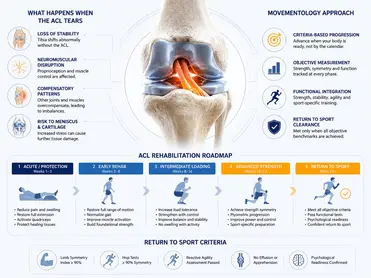
What happens to your knee when the ACL tears
Understanding what actually changes after an ACL rupture is the foundation of intelligent rehabilitation.
- Mechanical instability: Without the ACL, the tibia shifts abnormally under load. The meniscus and articular cartilage absorb stress they were never designed to manage alone.
- Neuromuscular disruption: The ACL is rich in mechanoreceptors — sensory nerve endings that feed real-time joint position data to the brain. Rupture doesn’t just break a ligament; it disrupts the entire proprioceptive feedback loop that keeps your knee stable during dynamic movement.
- Compensatory patterns: Without structured rehabilitation, the body offloads the injured knee. Hip, ankle, and lumbar spine mechanics change — creating secondary problems that can outlast the original injury.
This is why generic physiotherapy often falls short for complex ACL cases. Addressing pain and restoring basic range of motion is Level 1 care. Restoring neuromuscular control, load tolerance, and sport-specific function requires tertiary-level expertise.
The Movementology ACL rehab protocol — criteria-based, phase by phase
Each phase below has entry criteria and exit criteria. You do not leave a phase because of time. You leave it because your tissue has demonstrated readiness for the next level of load.
| PHASE | TIMEFRAME | EXIT CRITERIA — WHAT MUST BE ACHIEVED |
| Acute / protection | Weeks 1–3 | Swelling controlled, passive extension equal to opposite side, 90° flexion minimum, quad activation restored |
| Early rehab | Weeks 3–8 | Full passive range of motion, straight leg raise without extension lag, gait normalised without aids |
| Intermediate loading | Weeks 8–16 | Single-leg press >70% bodyweight, no effusion with loading, closed-chain exercises pain-free with good form |
| Advanced strength | Weeks 16–24 | Limb Symmetry Index (LSI) >80% on strength testing, single-leg hop within 80% of opposite side, no apprehension |
| Return-to-sport | Week 24+ | LSI ≥90% across all hop tests, reactive agility clearance, sport-specific movement screening passed, psychological readiness confirmed |
MOVEMENTOLOGY CLINICAL PRINCIPLE
Time heals tissue. Criteria-based progression restores function. These are not the same thing. A patient who reaches six months post-surgery without meeting strength symmetry criteria is not ready to return to sport — regardless of what the date says. We do not sign off on return until the objective benchmarks are met.
Quadriceps strengthening — the non-negotiable foundation
Quadriceps weakness is the most significant predictor of ACL re-rupture. It is also the most undertreated element of standard rehabilitation programmes. Restoring quad strength is not an optional extra — it is the primary clinical objective of ACL rehab.
- Weeks 1–3: Isometric quad sets, straight leg raises, terminal knee extensions — activating the muscle without placing stress on the healing ligament
- Weeks 4–8: Closed-chain loading begins — leg press, step-downs, split squats with careful attention to patellofemoral tracking
- Weeks 8+: Progressive resistance with neuromuscular integration — single-leg loading, reactive balance, eccentric strengthening
At Movementology, strength symmetry is tracked objectively throughout. The Limb Symmetry Index — the ratio of the operated limb’s strength to the unaffected side — is measured at each transition point. A patient with LSI below 90% does not advance to return-to-sport, regardless of how they feel subjectively.
ACL rehabilitation with concurrent meniscal involvement
ACL ruptures involve concurrent meniscal damage in a significant proportion of cases — and this fundamentally changes the rehabilitation approach. A meniscus-ACL protocol is not simply “slower.” It requires a different load sequencing strategy.
- Compressive loading must be carefully titrated — the meniscus requires axial load for synovial fluid circulation and cartilage nourishment, but excessive compression on damaged tissue accelerates degeneration
- Range of motion milestones are managed conservatively: full passive extension must be achieved before progressive flexion loading begins
- Deep flexion loading (beyond 90°) is deferred until meniscal healing benchmarks are confirmed clinically — not assumed by time
This is precisely where the BTL Zero Gravity Treadmill becomes clinically significant. By offloading up to 80% of body weight, it allows full gait-cycle training — heel strike, midstance, push-off — without placing compressive load on healing meniscal tissue. Patients who would otherwise be non-weight-bearing can maintain neuromuscular gait patterns and cardiovascular conditioning from week two of recovery. That changes outcomes.
Technology that serves the protocol — not the other way around
Movementology is equipped with clinical technology that most rehabilitation centres in Bengaluru do not have. But the equipment is not the point — the protocol is.
- BTL Zero Gravity Treadmill: Full gait training with up to 80% body weight reduction. Used from early rehab through return-to-sport running progression
- Storz Focused Shockwave (Storz Medical): For concurrent tendon pathology or delayed tissue healing — stimulates cellular repair without surgical intervention
- Super Inductive System: Deep neuromuscular stimulation for quadriceps activation in the early phase when pain-inhibition limits voluntary contraction
- Class IV Laser: Photobiomodulation to accelerate tissue healing and manage inflammation during acute and intermediate phases
Every technology decision at Movementology is made within the Arthrorehab protocol — our structured clinical methodology that determines which tool is used, when, and why. Any clinic can acquire equipment. What cannot be acquired is the clinical judgment to deploy it correctly.
Return to sport — what clearance actually means at Movementology
Return to sport is not a date. It is a set of objective criteria that must all be met before we sign off on full competitive activity. The research on ACL re-rupture is unambiguous: athletes who return before achieving quadriceps symmetry are at significantly higher risk of re-injury.
Movementology return-to-sport clearance criteria
- Limb Symmetry Index ≥90% on isokinetic or dynamometer strength testing
- Single-leg hop test (4-test battery) ≥90% symmetry
- Reactive agility assessment — sport-specific movement screening
- No effusion or apprehension with high-load functional movements
- Psychological readiness confirmed — ACL-RSI or equivalent tool
- Clinical sign-off from lead clinician — not administrative clearance
Patients who do not meet these criteria are not cleared — and are given a precise programme to address the specific gap holding them back. That transparency is not a failure of the rehabilitation. It is the highest form of clinical honesty.
Non-surgical ACL rehabilitation — when is it the right pathway?
Not every ACL rupture requires surgery. At Movementology, we evaluate each case individually — and for a significant number of patients, a structured non-surgical rehabilitation programme achieves full functional recovery.
Non-surgical ACL rehabilitation is a viable pathway for patients who meet specific criteria: partial tears with maintained stability, lower-demand activity profiles, older patients where surgical risk outweighs benefit, or patients who wish to exhaust every conservative option before committing to theatre. More than 900 patients at Movementology have avoided surgery through structured rehabilitation. That is not a marketing claim. It is a clinical outcome, documented case by case.
The decision between surgical and non-surgical pathways is made through a thorough clinical assessment — not a protocol default. If you have been told surgery is your only option, we would ask you to come and see us first.
At Movementology, every ACL rehabilitation programme is built around your specific injury, your tissue response, and your functional goals — not a standard template. Whether you are post-surgical, non-surgical, or still deciding, a specialist assessment with Dr. Padmanaban will give you a clear clinical picture and a precise recovery roadmap.
Book your assessment at Movementology
Frequently asked questions
- How long does ACL rehabilitation take at Movementology?The honest answer is: it depends on your tissue response, not a fixed timeline. Post-surgical ACL rehab typically takes 9–12 months to reach full return-to-sport criteria at Movementology — longer than many clinics quote, because we do not sign off on return until objective benchmarks are met. Non-surgical rehabilitation for suitable cases typically takes 3–6 months. Either way, progression is driven by criteria, not calendar dates.
- Can I recover from an ACL tear without surgery?Yes — for many patients, structured non-surgical rehabilitation through the Arthrorehab programme achieves full functional recovery. More than 900 Movementology patients have avoided surgery through this pathway. Whether non-surgical rehabilitation is right for you depends on the grade of tear, your activity demands, and your joint stability under load — all of which are assessed clinically at your first appointment.
- What is criteria-based rehabilitation and why does it matter for ACL recovery?Criteria-based rehabilitation means you progress through each phase of recovery when your body demonstrates readiness — through objective clinical tests — rather than when a fixed number of weeks has passed. For ACL rehab, this is critical: returning to sport before achieving quadriceps symmetry (Limb Symmetry Index ≥90%) significantly increases re-rupture risk. At Movementology, every phase transition is gated by criteria, not time.
- What is the Limb Symmetry Index and why does Movementology use it?The Limb Symmetry Index (LSI) compares the strength and function of the injured limb to the unaffected side, expressed as a percentage. An LSI of 90% or above across strength testing and hop tests is the minimum standard for return-to-sport clearance at Movementology — a threshold supported by current ACL outcome research. It removes subjective judgment from the return decision and replaces it with objective data.
- What if I had ACL surgery elsewhere and my recovery has stalled?This is one of the most common presentations we see at Movementology. Post-surgical ACL patients whose recovery has plateaued — typically stuck between 60–80% function — benefit significantly from a tertiary-level reassessment. We identify the specific deficit holding back progress and build a targeted programme around it. Surgery being technically successful does not guarantee full functional recovery. That is what rehabilitation is for.
Chief Physiotherapist, Lead Consultant – Advanced Orthopedic Rehabilitation